
The Penny Press and the New York Sun
To understand how the Great Moon Hoax succeeded, you have to understand the media environment that produced it. In the early 1830s, New York City's newspaper market was undergoing a revolution. The established papers — the Courier and Enquirer, the Journal of Commerce, the Morning Herald — sold for six cents per copy and catered to merchants, bankers, and the political class. They ran shipping manifests, commodity prices, and dense parliamentary debates. Working-class New Yorkers, who were increasingly literate but not wealthy, had little reason to buy them [3].
The penny press changed that. Benjamin Day founded the New York Sun in September 1833 with a radical proposition: a daily newspaper for one cent, funded primarily by advertising rather than subscription fees. The formula demanded sensation. To sell papers on the street corner — hawked by newsboys rather than delivered to subscribers — you needed headlines that grabbed a laborer or a shop clerk by the collar [1]. Crime reporting, human-interest stories, and spectacle became the Sun's stock in trade. Within two years of its founding, the Sun had the largest daily circulation in New York, surpassing papers that had been operating for decades.
It was into this environment — a market that rewarded audacity and punished dullness — that the Moon Hoax arrived in August 1835.
The First Installment
On August 25, 1835, the Sun published the first of six articles claiming that Sir John Herschel, the most famous astronomer in the world, had built a revolutionary telescope at the Cape of Good Hope and used it to observe life on the Moon [1]. The article appeared under the byline of a Dr. Andrew Grant, described as Herschel's colleague and travel companion, and claimed to be reprinted from a supplement to the Edinburgh Journal of Science.
Readers had no quick way to verify either claim. Transatlantic mail took weeks, sometimes months. The Edinburgh Journal of Science had actually ceased publication two years earlier, in 1833, when its editor David Brewster merged it with another periodical — but almost nobody in New York knew that [1]. The invocation of a respected British scientific journal gave the story an imprimatur of legitimacy that no American penny paper could have achieved on its own.
The first installment was relatively restrained. It described Herschel's supposed telescope in minute technical detail — a lens of twenty-four feet in diameter, a "hydro-oxygen" light source to magnify images, an unprecedented focal length that allowed resolution of objects on the lunar surface just eighteen inches across [3]. The scientific language was dense but internally consistent. It read like the proceedings of a learned society, not like a newspaper hoax.
The Content of the Articles
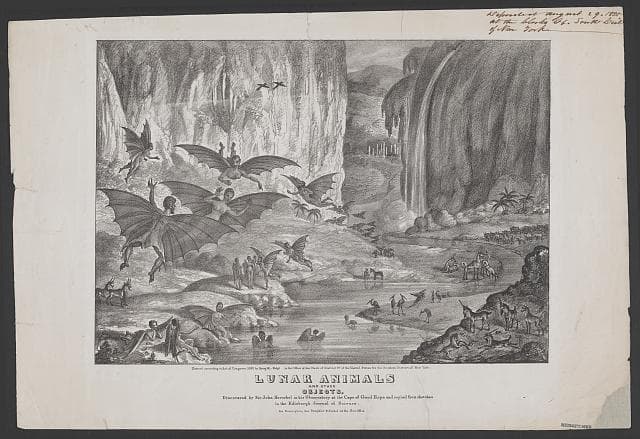
The six installments grew progressively more spectacular, following a narrative arc that built from the plausible to the fantastic. The first described geological features — basalt formations, crystal caves, towering amethyst obelisks, and forests of "dark red flowers" lining the shores of lunar oceans. The second introduced animals: goat-like creatures with a single horn, miniature zebras without stripes, and — most memorably — a biped beaver that lived in huts, walked on two legs, and appeared to use fire [2]. This last detail was presented with particular care, as if the author knew readers would need convincing.
The third installment expanded the catalogue of lunar life, describing birds of extraordinary plumage and crustaceans in coastal waters. But it was the fourth installment that ignited the true frenzy. The Sun described the bat-people — "Vespertilio-homo" in the pseudo-Linnaean taxonomy the articles employed — in lavish detail: about four feet tall, covered in short, glossy copper-colored hair except on the face, with membranous wings extending from their shoulders to their calves [1]. They walked upright, conversed through gestures and facial expressions, and appeared to live in organized social groups.
By the fifth article, the bat-people had constructed primitive temples of polished sapphire with roofs supported by massive columns. The articles specified their latitude and longitude on the lunar surface with scientific precision — 23 degrees north, near a formation the author called "the Ruby Colosseum" [2]. The sixth and final article described still more advanced lunar creatures, a superior race of bat-people with lighter complexions and an apparent system of governance, before the series abruptly ended with the claim that the telescope had been accidentally damaged by the sun's rays and observations could not continue.
The writing throughout was dense with technical language about the telescope's optics — focal lengths, hydro-oxygen reflectors, lens diameters, chromatic aberration — lending an air of scientific authority to what was, in every particular, completely fabricated [3].
Public Reaction
New York went wild. The Sun's circulation — already the largest of any daily paper in the city — reportedly hit 19,360, making it briefly the best-selling newspaper in the world [1]. Copies were passed hand to hand in taverns, offices, and churches. Crowds gathered outside the Sun's offices on Park Row demanding new installments. Back issues sold out immediately and had to be reprinted.
The story spread far beyond Manhattan. Other newspapers initially treated it as legitimate news. The New York Times (then the New York Daily Times) reported on it credulously. The Philadelphia newspapers reprinted summaries. Papers in New Orleans, Boston, and Baltimore picked up the story. A committee of scientists from Yale reportedly traveled to New York to inspect the "original" Edinburgh Journal supplement — and were sent on a runaround between the Sun's offices and its printing house until they gave up in frustration [2].
The public response was not merely credulous — it was enthusiastic. Church groups discussed whether the bat-people had souls and whether missionaries should be sent to the Moon. Ladies' societies proposed a collection to fund a lunar expedition. Some readers reportedly wept at the descriptions of the bat-people's apparent innocence and piety [3]. The hoax had tapped into a deep public hunger: the desire to believe that the universe was populated, that humanity was not alone, and that science was on the verge of proving it.
Even some members of the scientific community were initially taken in. The articles' technical language about optics was sophisticated enough to sound plausible to readers who lacked specialized knowledge — which included most of the educated public in 1835 [3]. Harriet Martineau, the British writer visiting America at the time, later recalled that she encountered the story being discussed as fact in drawing rooms and universities alike.
The Author
The hoax was perpetrated by Richard Adams Locke, a Cambridge-educated British journalist who had recently joined the Sun as a reporter [1]. Born in 1800 in East Brent, Somerset, Locke came from a family with scientific connections — he was reportedly a descendant of the philosopher John Locke, though this claim has been disputed. He studied at Cambridge but left without taking a degree, turning instead to journalism. He worked for several London papers before emigrating to New York in 1831, where he wrote for various publications before joining Benjamin Day's Sun in early 1835 [2].
Locke was a gifted writer with genuine knowledge of science journalism. He had covered lectures at scientific societies and reviewed books on optics and astronomy. He understood enough about lenses, celestial mechanics, and natural history to weave a story that sounded plausible paragraph by paragraph, even as the overall claims were absurd. His prose style — measured, precise, slightly dry — mimicked the tone of genuine scientific reports so effectively that readers had no stylistic cues to alert them to the fiction [3].
Locke never publicly admitted authorship during the series' initial run. When suspicions arose — first from rival paper the Journal of Commerce, whose reporter pressed the Sun's compositors for details — the Sun declined to confirm or deny the story's accuracy. The ambiguity was good for sales [2]. It was only weeks later, after Locke left the Sun following a salary dispute and a reporter from the Journal of Commerce published an exposé based on testimony from the Sun's own printing staff, that the hoax was broadly acknowledged.
Locke's motives remain somewhat debated. He later claimed the series was intended as a satire of the extravagant astronomical claims being made by Thomas Dick, a Scottish astronomer who had calculated that the solar system contained 21.9 trillion intelligent beings [4]. Whether this was a genuine artistic intention or a post-hoc rationalization is unclear. What is clear is that the hoax made the Sun a great deal of money and made Locke briefly famous.
Why It Worked
Several factors made the hoax possible. First, the penny press era had created a market for sensational news aimed at working-class readers who were less likely to have access to scientific journals or learned societies that might have raised objections [3]. The Sun cost one cent; establishment papers cost six. The Sun's readers wanted wonder, not sobriety. They were primed to believe in marvels because marvels sold papers, and the commercial incentive to debunk was weaker than the commercial incentive to amplify.
Second, Sir John Herschel was a real person conducting real astronomical observations at the Cape of Good Hope in 1835. He was the son of William Herschel, who had discovered Uranus in 1781, and he carried enormous scientific prestige. His reputation was genuine, and his distance from New York made verification impossible in any reasonable timeframe [1]. By the time Herschel himself learned of the hoax — months later, via a letter from a bewildered colleague — it had already run its course. He had no means of issuing a timely denial even if he wished to.
Third, the state of astronomical knowledge in 1835 left the Moon's surface genuinely mysterious. No one could prove the Moon was lifeless. The best telescopes of the era — Herschel's real instrument was powerful but nothing like the fantasy described in the articles — showed surface features but could not resolve details clearly enough to rule out vegetation or creatures [4]. The absence of evidence was not yet understood as evidence of absence. Respectable astronomers had speculated about lunar life within living memory. The idea was implausible but not yet impossible in the way it would become after later decades of improved observation.
Fourth, the articles were masterfully structured. They escalated gradually, beginning with claims that were almost mundane (rock formations, vegetation) and building toward the fantastic (intelligent bat-people, sapphire temples) only after readers had already accepted the premise. Each installment ended on a cliffhanger that demanded the next. The narrative arc resembled a novel more than a news report — which should have been a warning, but was instead a selling point [3].
Consequences
The Sun never issued a formal retraction or apology. When the hoax was exposed, the paper actually gained readers — people were entertained by the audacity and admired the craftsmanship [1]. Penny papers operated on the principle that any attention was good attention. Benjamin Day reportedly considered the hoax the finest moment in his paper's young history.
Rival editors were less amused. James Gordon Bennett of the New York Herald, himself no stranger to sensationalism, denounced the Sun while privately admiring the scheme's commercial success. The Journal of Commerce, which had led the debunking effort, gained a reputation for integrity — but not a proportional gain in circulation [2].
Herschel, when he finally learned of the affair, was reportedly amused at first but later grew annoyed as people continued to associate his name with fraud rather than his genuine scientific contributions [2]. His actual astronomical work at the Cape — cataloging stars and nebulae in the southern hemisphere, producing the first comprehensive star map of the southern sky — received less public attention than the fabricated Moon discoveries attributed to him. He complained in letters that the hoax had made him "the butt of a thousand jests" in ways that trivialized his life's work.
The Great Moon Hoax became a landmark in the history of American journalism. It demonstrated that in a media landscape built on speed and sensation rather than verification, a sufficiently well-written fabrication could override the public's critical faculties entirely [3]. Edgar Allan Poe, who had published his own Moon-travel fiction — "The Unparalleled Adventure of One Hans Pfaall" — in the Southern Literary Messenger just weeks earlier, was reportedly furious that Locke's version had stolen his thunder and received vastly more attention [4]. Poe later wrote a detailed analysis of the hoax's literary techniques, simultaneously criticizing and admiring Locke's work, and accused Locke of plagiarizing elements of his own story — a claim that has little supporting evidence.
Legacy
The Great Moon Hoax was not the last time an American newspaper would fabricate stories for circulation. The yellow journalism era of the 1890s — Hearst and Pulitzer competing for readers with invented atrocities in Cuba — the tabloid excesses of the 20th century, and the misinformation landscape of the 21st century all share DNA with what Richard Adams Locke did in August 1835 [1]. He proved that if you write confidently, cite authorities who cannot immediately respond, and give people what they want to believe, truth is optional.
The hoax also left a mark on science fiction. The detailed, pseudo-scientific style of the articles — the careful attention to making impossible claims sound like sober observation — prefigured the technique that Jules Verne and H.G. Wells would later perfect [4]. Locke demonstrated that the key to convincing scientific fiction was not imagination alone but the simulation of scientific method: observation, measurement, classification, restraint.
In a broader sense, the Moon Hoax illuminated something permanent about the relationship between the public and the press. Readers wanted to believe. They wanted a universe populated with wonders. They wanted science to deliver not just knowledge but spectacle. The Sun gave them what they wanted, and they thanked it with their pennies. The transaction was dishonest, but it was mutual [3].
The bat-people of the Moon were imaginary. But the human appetite for spectacular falsehoods dressed in scientific language was, and remains, entirely real.