
The Roswell Incident of 1947: A Tale of Confusion and Secrecy
In July 1947, something unusual happened in Roswell, New Mexico. The U.S. Army Air Forces initially announced that they had recovered a “flying disc” [1]. Just days later, they retracted that statement, claiming the debris was from a weather balloon [2]. This swift reversal set off a chain of events that would lead to decades of speculation, conspiracy theories, and the emergence of the Roswell incident as a cornerstone of UFO lore in America.
The Roswell incident has become synonymous with extraterrestrial encounters, but the truth behind the event is far more complex. The initial press releases, the subsequent investigations, and the eventual acknowledgment of Project Mogul all contribute to understanding what really happened in Roswell during that fateful summer.
The Initial Announcement: A “Flying Disc”
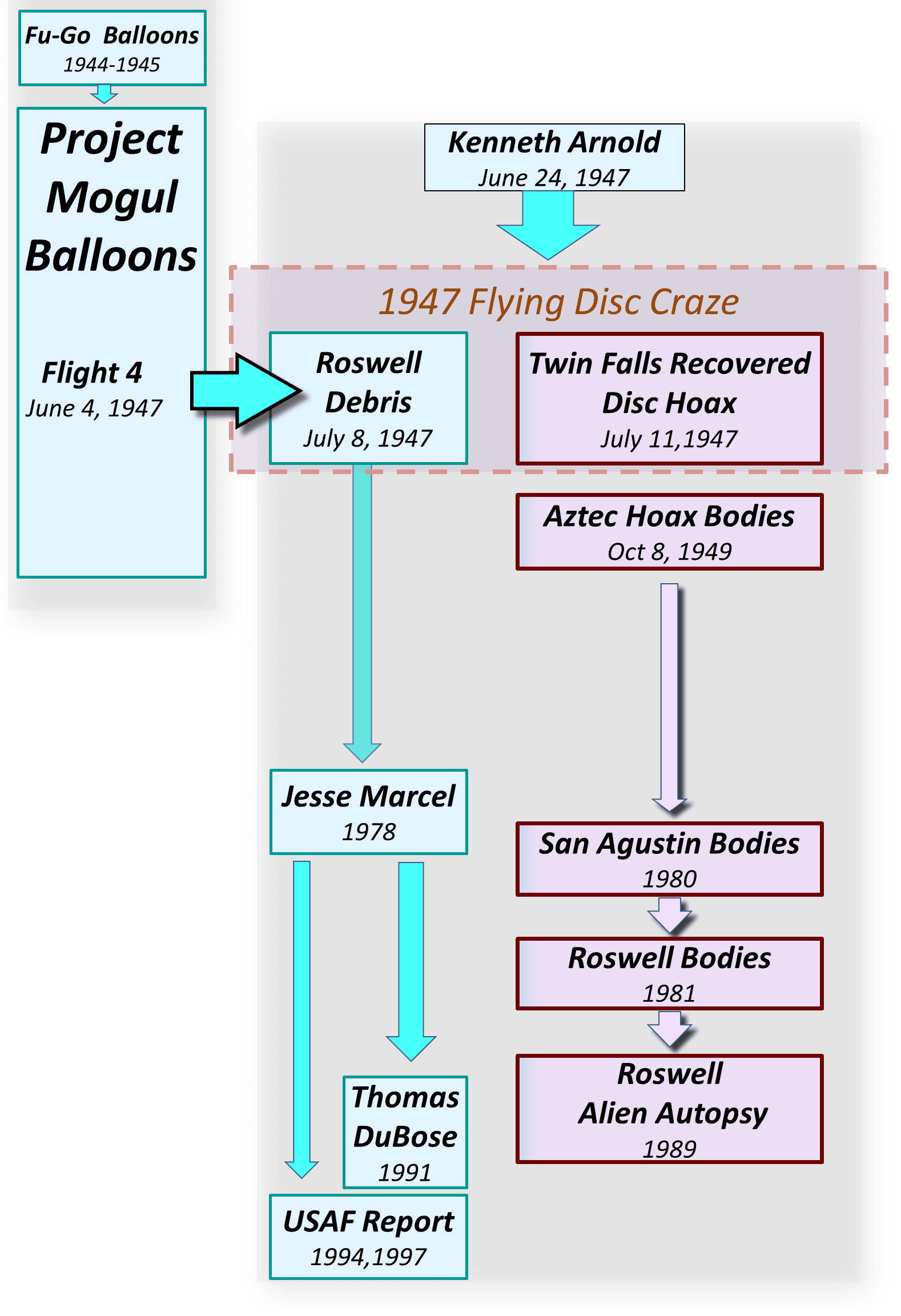
On July 8, 1947, the Roswell Army Air Field issued a press release stating that they had recovered a “flying disc” from a ranch near Roswell [1]. This announcement was made by Lieutenant Walter Haut, the public information officer at the base. The press release sparked immediate excitement and speculation about the possibility of extraterrestrial life. Newspapers across the country picked up the story, and the term “flying saucer” began to enter the American lexicon. The excitement was palpable, as many Americans were already captivated by the idea of UFOs following World War II, a time when technological advancements were at the forefront of public consciousness.
However, just a day later, the Army retracted its statement. Major Jesse Marcel, who had been involved in the recovery of the debris, appeared on radio and in newspapers to clarify that the materials were not from a flying disc but rather from a weather balloon [2]. This abrupt change in narrative raised eyebrows and fueled public curiosity about what really happened at Roswell. The quick retraction led many to suspect that the military was hiding something more significant than a simple case of mistaken identity.
The Weather Balloon Explanation
The Army’s explanation of a weather balloon was met with skepticism. Weather balloons were not new; they had been used for decades to gather meteorological data [5]. However, the materials recovered from the Roswell site did not match the typical debris associated with weather balloons. Witnesses described strange, metallic materials that were unlike anything they had seen before. Some reported that the debris had unusual properties, such as being incredibly lightweight yet incredibly strong, which further fueled speculation about its origins.
In the years following the incident, many witnesses came forward, claiming to have seen the wreckage and even alien bodies. These accounts varied widely, with some describing the debris as being lightweight and flexible, while others insisted it was heavy and metallic. The inconsistency in eyewitness accounts only added to the mystery surrounding the event. Some witnesses claimed to have seen military personnel handling the debris, while others reported seeing unusual symbols on the materials, leading to a plethora of theories about what had truly occurred.
Project Mogul: The Secret Behind the Debris
In the early 1990s, the U.S. Air Force released a report that provided a more detailed explanation of the Roswell incident. The report revealed that the debris recovered in 1947 was part of a classified program known as Project Mogul [2]. This project aimed to use high-altitude balloons to detect sound waves generated by Soviet nuclear tests. The program was shrouded in secrecy due to the Cold War tensions, and the materials used were not typical of what the public would expect from a weather balloon.
The materials used in Project Mogul were indeed unconventional. They included radar reflectors made of plastic and aluminum, which could have easily been mistaken for extraterrestrial technology by those unfamiliar with military equipment [5]. The report concluded that the initial confusion stemmed from the secretive nature of the project and the lack of clear communication from military officials. The Air Force's acknowledgment of Project Mogul was a significant moment in the history of the Roswell incident, as it provided a plausible explanation for the debris while simultaneously fueling further speculation about what else the government might be hiding.
The Role of Secrecy in the Roswell Incident
The secrecy surrounding Project Mogul played a significant role in shaping public perception of the Roswell incident. During the Cold War, the U.S. government was highly secretive about military operations and technology [3]. This culture of secrecy led to widespread speculation and conspiracy theories about what really happened in Roswell. The idea that the military would conceal information about UFOs became a popular narrative, especially as more people began to report sightings of unidentified flying objects in the years following the Roswell incident.
Many people believed that the government was covering up evidence of extraterrestrial life. This belief was not unfounded; the military's initial announcement and subsequent retraction created a vacuum of trust. The lack of transparency led to a fertile ground for conspiracy theories to flourish. Books and articles began to emerge, suggesting that the government was not only aware of extraterrestrial life but actively engaged in a cover-up to prevent public panic. The Roswell incident became a symbol of the broader distrust many Americans felt toward their government during this tumultuous period.
Eyewitness Accounts: A Mixed Bag of Testimonies
Eyewitness accounts from the Roswell incident vary significantly, contributing to the ongoing debate about what truly happened. Some witnesses, like Jesse Marcel, claimed that the debris was unlike anything they had ever seen. Marcel’s son later reported that his father had told him the materials were “not of this Earth” [4]. This statement, along with Marcel's position as a military officer, gave weight to the claims of extraterrestrial involvement.
Other witnesses, however, were more skeptical. Some ranchers who found the debris described it as nothing more than a weather balloon [2]. This disparity in accounts has fueled conspiracy theories, with some suggesting that the witnesses who claimed to have seen alien technology were either mistaken or influenced by the sensational media coverage. The conflicting testimonies have led to a fragmented narrative that complicates the understanding of the incident. Some witnesses later recanted their stories, while others remained steadfast in their beliefs, further muddying the waters of what actually transpired.
The Impact of the Roswell Incident on UFO Culture
The Roswell incident has had a lasting impact on American culture and the global perception of UFOs. In the decades following the event, interest in unidentified flying objects surged. The 1950s and 1960s saw a proliferation of UFO sightings, and the Roswell incident became a touchstone for those who believed in extraterrestrial life [4]. The incident inspired a wave of literature, documentaries, and films that explored the possibility of alien encounters, often framing the government as a secretive entity hiding the truth from the public.
Books such as "The Roswell Incident" by Charles Berlitz and William L. Moore, published in 1980, played a crucial role in popularizing the narrative of a government cover-up. The book presented a detailed account of the incident and included testimonies from various witnesses, further embedding Roswell into the fabric of UFO lore. Documentaries and television shows, including the popular series "The X-Files," have also drawn on the Roswell narrative, reinforcing the idea that the government is concealing information about extraterrestrial life.
Moreover, the Roswell incident has influenced how the public perceives UFOs and the possibility of alien life. It has become a symbol of the unknown and the potential for life beyond Earth. The fascination with Roswell continues to thrive, as new generations of enthusiasts seek to uncover the truth behind the incident. The rise of the internet has only intensified this interest, with countless forums and websites dedicated to discussing the Roswell incident and related conspiracy theories.
The 1990s: Renewed Interest and Official Reports
In the early 1990s, the U.S. Air Force published two reports that reignited interest in the Roswell incident. The first, released in 1994, acknowledged that the debris recovered in 1947 was indeed part of Project Mogul [2]. This report aimed to clarify the confusion surrounding the initial press release and the subsequent retraction. It provided a detailed account of the project, including the materials used and the purpose of the high-altitude balloons.
In 1997, the Air Force released a second report that addressed claims of alien bodies being recovered at the Roswell site. This report concluded that the stories of alien bodies were likely the result of misidentified military tests involving anthropomorphic dummies, which were used in high-altitude balloon experiments [2]. The use of these dummies in the 1950s and 1960s led to further confusion and speculation about the Roswell incident. The reports were met with mixed reactions; while some saw them as a definitive explanation, others remained unconvinced, believing that the government was still withholding critical information.
The renewed interest in the Roswell incident during the 1990s coincided with a broader cultural fascination with UFOs and extraterrestrial life. The decade saw the emergence of numerous UFO conventions and gatherings, where enthusiasts would share their theories and experiences. The Roswell incident became a central theme in these discussions, often cited as the quintessential example of a government cover-up.
The Legacy of Roswell: A Cultural Phenomenon
The Roswell incident has transcended its origins as a military mishap to become a cultural phenomenon. It has inspired countless books, documentaries, and movies, and has been referenced in popular culture from television shows to music. The idea of a government cover-up of extraterrestrial life has become a central theme in science fiction and conspiracy theories. The incident has also influenced the way UFOs are portrayed in media, often depicted as mysterious and otherworldly, reinforcing the notion that there is more to the story than what is publicly known.
Moreover, the Roswell incident has influenced how the public perceives UFOs and the possibility of alien life. It has become a symbol of the unknown and the potential for life beyond Earth. The fascination with Roswell continues to thrive, as new generations of enthusiasts seek to uncover the truth behind the incident. The rise of the internet has only intensified this interest, with countless forums and websites dedicated to discussing the Roswell incident and related conspiracy theories. The annual Roswell UFO Festival, which attracts thousands of visitors, serves as a testament to the enduring legacy of the incident.
The Enduring Mystery of Roswell
Despite the U.S. Air Force’s attempts to clarify the events of 1947, the Roswell incident remains shrouded in mystery. The combination of initial confusion, government secrecy, and a culture of speculation has ensured that Roswell will continue to be a focal point for UFO enthusiasts and skeptics alike. The incident has become a cultural touchstone, representing the intersection of science, mythology, and the human desire to explore the unknown.
What happened at Roswell in 1947 may never be fully understood, but the incident serves as a reminder of the human desire to explore the unknown and the lengths to which people will go to seek answers. Whether viewed as a simple case of mistaken identity or a complex web of military secrecy, the Roswell incident has left an indelible mark on American history and culture. As new evidence and testimonies continue to emerge, the Roswell incident remains a captivating subject for those intrigued by the mysteries of the universe.