
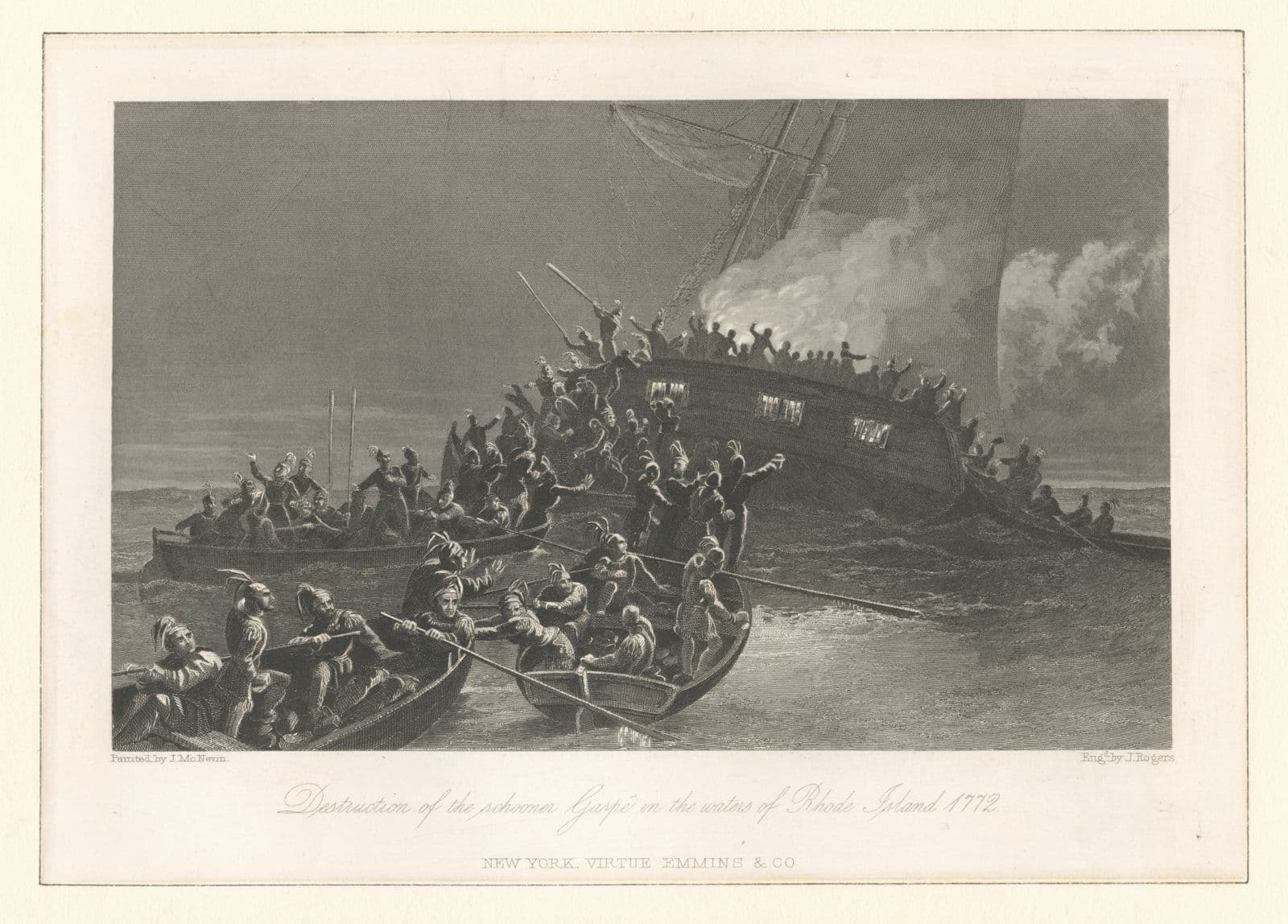
In the early morning hours of June 10, 1772, a group of Rhode Island colonists boarded and burned the HMS Gaspee, a British customs schooner. This act of defiance occurred in Narragansett Bay, just off the coast of Providence, and marked one of the first significant acts of rebellion against British authority in the American colonies [1]. The Gaspee Affair not only highlighted the growing tensions between colonists and the British government but also set the stage for further revolutionary actions leading up to the American Revolution [5].
The HMS Gaspee and Its Mission
The HMS Gaspee was a small, armed customs schooner commissioned by the British government to enforce trade regulations in the American colonies [4]. Launched in 1764, the ship was tasked with patrolling the waters of Narragansett Bay to prevent smuggling and ensure compliance with the Navigation Acts, which restricted colonial trade to British ships [3]. The Gaspee was notorious among the colonists for its aggressive enforcement of these laws, often stopping vessels and searching them for contraband.
By 1772, tensions in the colonies were escalating. The British government had increased its efforts to collect taxes and enforce trade regulations, leading to widespread resentment among colonists [2]. The Gaspee's captain, Lieutenant William Dudingston, was particularly zealous in his duties, which made him a target of colonial anger. His harsh methods and the ship's presence in Rhode Island waters were seen as symbols of British oppression. The Gaspee's reputation for aggressive enforcement contributed to a growing sense of injustice among the local population, who felt that their rights were being trampled upon by an overreaching government.
The Grounding of the Gaspee
On June 9, 1772, the HMS Gaspee ran aground near Namquid Point while pursuing a suspected smuggler [1]. The ship's grounding was a significant turning point; it left the Gaspee vulnerable and isolated. This incident occurred during the night, and the tide quickly receded, leaving the vessel stuck. This presented an opportunity for the local colonists, who had been increasingly frustrated with British interference in their daily lives.
News of the Gaspee's predicament spread quickly through the local community. The ship's grounding was seen not only as a chance to retaliate against British authority but also as a moment of collective action among the colonists. Several prominent figures in Rhode Island began to organize a response, recognizing the potential for a unified act of defiance. The situation was ripe for rebellion, and the colonists were eager to seize the moment.
The Raid on the Gaspee
The raid on the Gaspee was led by a group of local patriots, including John Brown, a wealthy merchant and prominent member of the Rhode Island Sons of Liberty [2]. Brown and his associates gathered a group of around 60 men, many of whom were from the surrounding area. They set out in small boats under the cover of darkness, intent on destroying the ship. The decision to act was not taken lightly; it was a calculated risk that reflected the growing frustration with British rule.
As they approached the grounded Gaspee, the colonists were met with little resistance. The crew, caught off guard and unable to maneuver their ship, was quickly overpowered. The men boarded the Gaspee, capturing Lieutenant Dudingston and his crew. The colonists then set fire to the ship, watching as it burned to the waterline [3]. The act was both a statement of defiance and a rallying cry for other colonists who were growing increasingly dissatisfied with British rule.
The burning of the Gaspee was not just an isolated incident; it was part of a larger pattern of resistance against British authority. The event galvanized support for the growing revolutionary movement and demonstrated that colonists were willing to take direct action against what they viewed as tyranny [4]. The Gaspee Affair became a symbol of resistance, inspiring similar acts of defiance in other colonies.
British Response and Investigation
The British government was alarmed by the burning of the Gaspee. It viewed the incident as a serious challenge to its authority in the colonies. In response, the British Parliament established a commission of inquiry to investigate the affair [1]. This commission was tasked with identifying the individuals responsible for the attack and bringing them to justice. The British authorities were determined to make an example of the raiders, hoping to deter further acts of rebellion.
The investigation faced significant challenges. Many colonists were unwilling to cooperate with the British authorities, viewing the Gaspee Affair as a justified act of resistance. The local population largely supported the actions of the raiders, and there was a strong sense of solidarity among the colonists. This made it difficult for the British to gather evidence and identify the perpetrators. The colonists' refusal to cooperate was a clear indication of their growing discontent with British rule.
Despite the challenges, the British authorities attempted to assert their power. They offered rewards for information leading to the arrest of the raiders, but this only fueled further resentment among the colonists. Many viewed the investigation as an infringement on their rights and an attempt to intimidate them into submission. The British response to the Gaspee Affair only deepened the divide between the colonies and the crown, further inflaming revolutionary sentiments [5].
The Impact of the Gaspee Affair on Colonial Unity
The Gaspee Affair had a profound impact on the colonies, serving as a catalyst for greater unity among the American colonists. The event highlighted the growing divide between Britain and its colonies, as well as the willingness of colonists to take direct action against perceived injustices. It also demonstrated the effectiveness of organized resistance, as the raid on the Gaspee was a coordinated effort that involved multiple individuals and groups [4].
In the wake of the Gaspee Affair, the colonies began to form committees of correspondence. These committees were established to facilitate communication and cooperation among the colonies in response to British policies. The Gaspee Affair served as a rallying point for these committees, as they sought to coordinate their efforts against British rule. This newfound unity among the colonies was crucial in laying the groundwork for the collective actions that would follow.
The incident also contributed to the growing sentiment for independence among the colonists. Many began to see the British government as an oppressive force that needed to be challenged. The Gaspee Affair was one of the first instances where colonists took a stand against British authority in a violent manner, setting a precedent for future acts of rebellion. The event underscored the idea that resistance was not only justified but necessary in the face of tyranny [5].
The Legacy of the Gaspee Affair
The legacy of the Gaspee Affair is significant in the context of American history. It is often viewed as a precursor to the larger revolutionary movements that would follow, including the Boston Tea Party and the battles of Lexington and Concord [2]. The event demonstrated the willingness of colonists to take drastic measures in defense of their rights and liberties. The Gaspee Affair is frequently cited as an early example of the growing revolutionary spirit that would ultimately lead to the American Revolution.
In 1856, the Gaspee Affair was commemorated by the establishment of Gaspee Days, a celebration in Rhode Island that honors the events of June 10, 1772 [2]. This annual event includes a reenactment of the burning of the Gaspee, as well as various activities that celebrate Rhode Island's role in the American Revolution. Gaspee Days serves as a reminder of the importance of the affair in the broader narrative of American independence. It highlights the enduring legacy of the Gaspee Affair and its role in shaping the identity of Rhode Island as a center of revolutionary activity.
The Gaspee Affair also played a role in shaping the narrative of the American Revolution. It highlighted the growing discontent among colonists and their willingness to resist British authority. The event is often cited as an example of the grassroots activism that characterized the revolutionary movement, as ordinary citizens took it upon themselves to challenge the status quo. This grassroots resistance was essential in mobilizing support for the revolutionary cause and fostering a sense of shared purpose among the colonies [5].
The Gaspee Affair and the Road to Independence
The Gaspee Affair was not just a singular event; it was part of a larger tapestry of resistance against British rule. The actions taken by the Rhode Island colonists resonated throughout the colonies, inspiring others to take similar stands against British authority. The incident was a clear indication that the colonists were willing to go to great lengths to protect their rights and liberties.
As tensions continued to escalate in the years leading up to the American Revolution, the Gaspee Affair served as a reminder of the power of collective action. It highlighted the importance of grassroots movements in shaping the course of history and underscored the significance of local events in the broader narrative of the struggle for independence. The Gaspee Affair demonstrated that the fight for liberty was not confined to the halls of power but was rooted in the everyday lives of ordinary citizens.
The aftermath of the Gaspee Affair also saw an increase in revolutionary literature and propaganda. Pamphlets and newspapers began to circulate, framing the incident as a heroic act of resistance against tyranny. This helped to galvanize public opinion and further unify the colonies in their opposition to British rule. The Gaspee Affair became a rallying point for those advocating for independence, as it exemplified the colonists' resolve to stand up against oppression [4].
Conclusion: The Gaspee Affair as a Turning Point
The burning of the HMS Gaspee was a pivotal moment in American history. It marked one of the first instances of organized resistance against British authority and set the stage for the larger revolutionary movements that would follow. The Gaspee Affair demonstrated the growing unity among the colonies and the willingness of colonists to take direct action in defense of their rights.
As tensions continued to escalate in the years leading up to the American Revolution, the Gaspee Affair served as a reminder of the power of collective action. It highlighted the importance of grassroots movements in shaping the course of history and underscored the significance of local events in the broader narrative of the struggle for independence. The legacy of the Gaspee Affair continues to resonate today, as it serves as a testament to the spirit of resistance and the pursuit of liberty that defined the American Revolution. The events of June 10, 1772, remain a crucial part of the story of America's fight for independence.