
The Glowing Paint
In 1917, the United States Radium Corporation opened a factory in Orange, New Jersey, to manufacture glow-in-the-dark watch dials for the U.S. military. The paint — a mixture of radium, zinc sulfide, and adhesive — made numbers readable in the dark, an essential feature for soldiers reading watches in trenches [1]. The women hired to apply the paint were called "dial painters." Most were teenagers or young women in their early twenties, drawn from working-class families in the surrounding neighborhoods of Orange and Newark. They were paid per dial — roughly 1.5 cents each — and speed was everything. A fast painter could finish over 250 dials per day, earning the equivalent of what a typical factory worker made, which made the job attractive to young women with few other options [3].
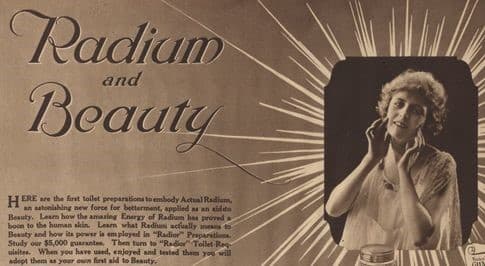
To achieve the fine brushstrokes needed for tiny numbers, supervisors taught the women to shape their brush tips by placing them between their lips — a technique called "lip-pointing" [2]. Each painter ingested radium dozens of times per day. A single session might involve lip-pointing the brush hundreds of times. The company assured them the paint was harmless — some managers even suggested that radium was a health tonic, consistent with the era's widespread belief that radium possessed curative properties. Patent medicines containing radium were sold openly to the public throughout the 1920s [3]. Some women painted their nails and teeth with it for fun, enjoying the ghostly glow. They dusted it on their hair and evening dresses before dances, calling themselves "ghost girls" [1].
What Radium Does to the Body
Radium is chemically similar to calcium. When ingested, the body incorporates it into bones, where it remains and emits alpha radiation — destroying bone tissue from within [1]. The effects are cumulative and irreversible. Unlike external radiation burns, which heal if exposure stops, radium deposited in bone continues irradiating surrounding tissue indefinitely. As the radium decays, it produces radon gas, which accumulates in the bone marrow and further damages surrounding cells. The alpha particles shatter DNA strands, triggering cancers — particularly osteosarcoma, a bone cancer — and causing a condition called "radium jaw," in which the mandible and maxilla literally necrotize and disintegrate [4].
The workers did not know this. The company's own scientists did know. Internal memos from as early as 1924 documented the dangers of radium ingestion. The company's founder, physician Sabin von Sochocky, had already lost a finger to radium exposure. Male chemists at the plant handled radium with tongs, lead aprons, and forceps [4]. The women were given no protection whatsoever — no gloves, no masks, no ventilation. The contrast was stark and deliberate: the company understood the hazard but applied precautions only to its higher-paid male employees.
The First Symptoms
By 1922, workers began reporting dental problems — loosening teeth, jaw pain, abscesses that would not heal. Dentists pulled teeth and found the jaw bones underneath crumbling like chalk. In some cases, sections of jaw simply broke away from the face [2]. The women developed what doctors would later call "radium jaw": a necrosis of the facial bones so severe that pieces of jawbone could be extracted with fingers. The decay emitted a foul, putrid odor that made social contact unbearable for the sufferers.
Mollie Maggia, one of the earliest and most tragic cases, began experiencing tooth pain in 1921. Over the following months, her dentist extracted tooth after tooth, but the infections only worsened. Her jawbone had turned soft andite — when her dentist probed the area, he pulled out an entire chunk of her lower jaw along with a tooth. Her mouth and throat ulcerated. Her bones fractured spontaneously. She bled from her mouth, nose, and ears in her final weeks. She died in September 1922 at age 24 — officially listed as dying from syphilis, a diagnosis her family always denied and which was later conclusively disproven by exhumation and forensic analysis in 1927 [1]. The syphilis diagnosis was not accidental. It served the company's interests by discrediting a dead worker and discouraging other women from seeking medical attention.
Grace Fryer, another dial painter who had worked at the Orange factory from 1917 to 1920, began suffering joint pain and tooth loss in 1923. Her dentist noticed her jaw was luminescent in the dark — the radium had so saturated her bones that they glowed [3]. Fryer's spine began to collapse, and she was eventually fitted with a steel back brace that she wore for the rest of her life. Hazel Vincent, another worker, developed massive tumors on her hips and legs. Irene Rudolph's jaw had to be surgically removed, leaving her face permanently disfigured [2].
Amelia "Mollie" Maggia's sister, Quinta McDonald (née Maggia), also worked as a dial painter. She too developed bone deterioration and would later become one of the five women to sue the company. A third Maggia sister, Albina Larice, joined the lawsuit as well. Three sisters from the same family — all poisoned in the same factory [1].
The Company's Response
United States Radium Corporation denied that its paint caused illness. When workers sought medical opinions, the company hired physicians to examine them and produce reports blaming "phosphorus necrosis" or other conditions [4]. When worker Mollie Maggia's death was attributed to syphilis — a socially devastating diagnosis for a young woman in the 1920s — the company did not correct the record. The syphilis label accomplished exactly what the company needed: it reframed a workplace poisoning as a private sexual disgrace, silencing questions from other workers and their families.
The company also commissioned a study from Cecil Drinker of Harvard University's School of Public Health. Drinker's team visited the Orange factory in 1924 and conducted blood tests on the workers. Every single woman tested showed blood abnormalities. Drinker's report concluded that conditions at the plant were dangerous and that workers had been poisoned by radium. United States Radium Corporation suppressed the report and published a fraudulent version stating the factory was safe [2]. When Drinker protested, the company ignored him. It took years before the authentic report surfaced.
The company also hired Dr. Frederick Flinn of Columbia University to conduct "independent" examinations of the workers. Flinn, who had no medical license, declared the women healthy. He published papers asserting that radium exposure at the factory was not harmful. It was later revealed that Flinn was secretly on the company's payroll the entire time [4].
The Lawsuit
In 1927, five dial painters — Grace Fryer, Edna Hussman, Katherine Schaub, Quinta McDonald, and Albina Larice — filed suit against United States Radium Corporation [1]. Finding a lawyer willing to take the case took Grace Fryer two full years of searching. The company was wealthy and well-connected. Local attorneys feared retaliation and recognized that the case would pit them against powerful corporate interests with deep resources for legal warfare.
The women were eventually represented by Raymond Berry, a young attorney with little to lose. The case attracted national media coverage. Reporters described the women's deteriorating conditions in wrenching detail: Grace Fryer wore a steel back brace and could barely raise her arm to take the oath. Katherine Schaub's face was visibly deformed from jaw necrosis, and she had lost most of her teeth. Edna Hussman was carried into the courtroom on a stretcher, too weak to walk [3]. Newspapers dubbed them "the Radium Girls," and their plight became a national sensation, generating public sympathy and outrage.
The company's defense was delay. They argued the statute of limitations had expired and demanded endless continuances, calculating — correctly — that the plaintiffs might die before trial. The women's own doctors estimated they had less than a year to live. The judge, William Clark, facing enormous public pressure and aware of the plaintiffs' declining health, pushed aggressively for a settlement. In June 1928, the case was resolved: each woman received $10,000 (roughly $180,000 in today's money), a $600 annual pension, and coverage of all medical and legal expenses [4].
Most of the five were dead within two years of the settlement. Quinta McDonald died in 1929. Albina Larice died in 1946 after years of suffering. Grace Fryer died in 1933 at age 34.
The Wider Campaign
The New Jersey cases were not isolated. Similar factories operated in Connecticut, Illinois, and elsewhere. In Waterbury, Connecticut, the Waterbury Clock Company employed dial painters under nearly identical conditions. In Ottawa, Illinois, the Radium Dial Company employed hundreds of women under identical conditions. When workers there began showing the same symptoms in the late 1920s, the company hired a friendly physician who diagnosed them with "bacterial infections" [2]. The company president, Joseph Kelly, went further — he told workers that radium would make them healthy, that it would "put rosy cheeks" on them.
Catherine Wolfe Donohue, an Ottawa dial painter who had worked at the factory from 1922 to 1931, was diagnosed with radium poisoning in the mid-1930s. By then her bones were riddled with holes, her teeth had fallen out, and her immune system was failing. She pursued her case through the Illinois courts despite being so ill she had to be carried into hearings on a stretcher. Photographs from the trial show her lying prone, barely able to lift her head to give testimony [1].
Her case, which she won in 1938 after an agonizing series of appeals, established the right of workers to sue employers for occupational diseases under Illinois law — even after leaving employment [1]. The ruling was a landmark: it meant that companies could not simply wait out the clock while their former employees sickened and died.
Donohue died on July 27, 1938 — less than a year after her victory. She was 34.
Legal and Scientific Legacy
The Radium Girls' cases directly led to multiple reforms that reshaped American labor law. The lawsuits established precedents that occupational diseases could be compensated under workers' compensation laws — previously, most states only covered acute injuries like broken limbs or lacerations, not diseases that developed over months or years [4]. They contributed to the development of OSHA's predecessor agencies and to the classification of radium as a dangerous substance requiring strict workplace controls. Industrial hygiene — the science of identifying and controlling workplace health hazards — became a recognized discipline in large part because of these cases.
The cases also helped establish the legal principle that employers have a duty to inform workers of known health risks in the workplace. This concept, now considered fundamental, was essentially nonexistent before the Radium Girls' lawsuits. Their fight laid groundwork that would eventually be codified in the Occupational Safety and Health Act of 1970 [4].
Scientifically, the dial painters became involuntary research subjects. The Argonne National Laboratory studied surviving dial painters for decades, beginning in the 1940s. The Center for Human Radiobiology tracked these women and other radium-exposed workers, using their bone scans, blood samples, and autopsy results to establish baseline data on radiation's long-term effects on the human body [1]. Researchers measured the radium content in their bones and correlated it with specific health outcomes. This data was later used to set safety standards for nuclear workers during the Manhattan Project and the Cold War. The maximum permissible body burden of radium — 0.1 micrograms — was calculated directly from the dial painters' data [2].
The dial painters' bodies were so thoroughly saturated with radium that when researchers exhumed some of them decades after death, their bones still registered on Geiger counters. Mollie Maggia's remains, exhumed in 1927, glowed in the dark [3].
The Numbers
Historians estimate that several thousand women worked as dial painters across the United States between 1917 and the early 1930s [3]. At least 50 died directly from radium poisoning. Many more suffered chronic health effects — spontaneous bone fractures, severe anemia, leukemia, osteosarcoma, and reproductive damage — that shortened their lives without being formally attributed to their factory work. Some women survived for decades but lived with constant pain, crumbling bones, and the knowledge that the radiation inside them would never stop.
The company's founder, Sabin von Sochocky, died of aplastic anemia caused by radium exposure in 1928. He was 46 [2]. His death carried a grim irony: the man who had invented the luminous paint and built a corporation on it was killed by the same substance he had allowed his workers to ingest by the mouthful.
Memory
The Radium Girls' story was largely forgotten for decades before being rediscovered by historians and journalists in the 2000s and 2010s. Kate Moore's 2017 book *The Radium Girls: The Dark Story of America's Shining Women* brought it to popular attention and introduced a new generation to their fight. In 2018, a memorial statue was erected in Ottawa, Illinois, honoring Catherine Donohue and the other Illinois dial painters [1]. In Orange, New Jersey, the site of the original factory — long since demolished — was designated a Superfund site due to lingering radium contamination in the soil.
Their story remains a stark reminder that corporations will sometimes knowingly poison their workers and spend years denying it — and that the workers who fight back often do not live to see justice.