
The Dam
The St. Francis Dam stood in San Francisquito Canyon, approximately 40 miles northwest of Los Angeles. Built between 1924 and 1926, it was a concrete gravity-arch dam, 205 feet high and 700 feet across, holding approximately 12.4 billion gallons of water in a reservoir that served as backup supply for the city of Los Angeles [1]. It was designed and built under the direction of one man: William Mulholland, the self-taught engineer who had constructed the Los Angeles Aqueduct and transformed a desert town into a metropolis.
Mulholland was 72 years old and at the peak of his power. He was the most important civic figure in Los Angeles history — the man who had solved the unsolvable problem of bringing water across 233 miles of desert from the Owens Valley to a city that had no natural right to grow. He answered to no oversight board. He employed no independent consultants. The Bureau of Water Works and Supply operated essentially as his personal fiefdom, and the St. Francis Dam was built without external engineering review of any kind [2]. And the dam he built had been leaking from the day it was filled.
Mulholland's Rise
William Mulholland arrived in Los Angeles in 1877 as a penniless Irish immigrant. He had no formal engineering education — he had worked as a sailor, a lumber hand, and a well digger. He taught himself hydraulic engineering by reading textbooks at night while working as a ditch tender for the Los Angeles City Water Company [1]. Through sheer intellect and relentless ambition, he rose to become superintendent of the entire water system by 1886.
His masterwork was the Los Angeles Aqueduct, completed in 1913 — a gravity-fed system that carried water from the Owens River across mountains and desert without a single pump. It was a genuine marvel of engineering, and it made Mulholland the most celebrated public servant in Southern California [2]. But the aqueduct also made him arrogant. By the 1920s, he had been building water infrastructure for decades without a significant failure, and he trusted his own judgment absolutely. The St. Francis Dam was conceived during ongoing conflicts with Owens Valley farmers who were dynamiting sections of the aqueduct. Mulholland wanted a large local reservoir as insurance — a backup supply that could sustain the city if the aqueduct were interrupted [3]. Speed and secrecy mattered more to him than caution.
Construction and Warning Signs
The St. Francis Dam was constructed on a geologically unsuitable foundation. One abutment rested on ancient landslide debris — a jumbled mass of rock that had slid into the canyon thousands of years earlier and was inherently unstable. The other sat on a formation of mica schist, a type of metamorphic rock that dissolved and weakened when in prolonged contact with water [1]. These facts were either unknown to Mulholland — who had no formal geology training and conducted no geological surveys — or dismissed as irrelevant.
During construction, Mulholland made a fateful decision to increase the dam's height by 20 feet — from 185 feet to 205 feet — without correspondingly widening its base [4]. This modification increased the reservoir's capacity by roughly 30% but significantly reduced the dam's structural margin of safety. The additional height was achieved by simply adding concrete to the top, a decision that no independent review board would likely have approved.
The dam began leaking almost immediately after the reservoir was first filled in 1926. Workers reported muddy water seeping from the base and from the canyon walls near the abutments. Cracks appeared in the concrete. The road crossing the dam's crest developed visible fissures [2]. On the morning of March 12, 1928, the dam keeper Tony Harnischfeger reported new leaks to Mulholland personally — the water was brown and muddy, suggesting it was carrying material from within the dam structure itself [3]. Mulholland drove to the dam site, inspected the leaks, declared them normal seepage, and went home.
Twelve hours later, the dam ceased to exist.
The Collapse
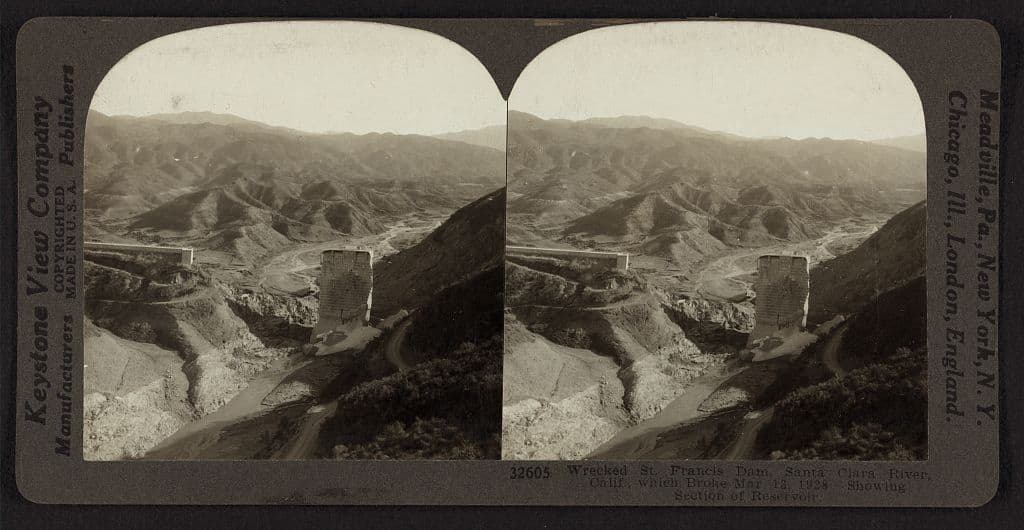
At 11:57 p.m. on March 12, 1928, the St. Francis Dam failed catastrophically. The entire structure did not overtop or develop a gradual breach — it disintegrated. The center section and the eastern abutment broke away simultaneously as the ancient landslide material beneath the east wing liquefied under the relentless pressure of 12 billion gallons, releasing the full contents of the reservoir in a single cataclysmic surge [1].
The initial wave was estimated at 140 feet high as it roared down San Francisquito Canyon. Moving at approximately 18 miles per hour, the flood wave carried blocks of concrete — some weighing 10,000 tons — for over half a mile downstream [2]. The sound was described by distant witnesses as a continuous roar like sustained thunder. Within five minutes, it obliterated a construction camp housing 150 workers for a new power station being built by Southern California Edison. Eighty-four of them died in their beds without ever waking. Tony Harnischfeger, the dam keeper who had reported the leaks that morning, was among the first to die — his body was never found, though the body of his six-year-old son Coder was recovered downstream [3].
The concrete fragments that remained standing — jagged pieces of the dam's wings jutting from the canyon walls — testified to the violence of the failure. Engineers who examined the ruins noted that the dam had not simply broken; it had been blown outward by the sudden release of pressure, scattering pieces across a debris field that stretched for miles [4].
The Path of Destruction
The flood traveled 54 miles from the dam site to the Pacific Ocean at Ventura, taking approximately five and a half hours to complete the journey [3]. As it moved downstream through the Santa Clara River Valley, it destroyed everything in its path: farms, ranches, towns, bridges, railroads, and orchards. The wave picked up debris as it traveled — trees, vehicles, building materials, livestock — becoming a churning mass of mud and wreckage that scoured the valley floor to bedrock in places.
The towns of Castaic Junction, Fillmore, Bardsdale, and Santa Paula were inundated. In some areas, the floodwater spread more than two miles wide and stood 70 feet deep [1]. Houses were torn from foundations and carried miles. Livestock — thousands of cattle, horses, and chickens — were swept away. Entire citrus orchards that had taken decades to mature were scoured to bare earth in minutes. The town of Santa Paula received a telephone warning roughly 90 minutes before the flood arrived, allowing some residents to flee to higher ground, but many downstream communities had no warning at all [2].
The Southern California Edison powerhouse at Power Station No. 2, located just below the dam, was destroyed instantly. The 64 men, women, and children living at the Edison construction camp in San Francisquito Canyon had virtually no chance of survival. Downstream, the Saugus substation and the Montalvo bridge were swept away. The Southern Pacific railroad line was buried under 20 feet of debris across a five-mile stretch [3].
The dead were found for months afterward — in mud deposits, tangled in debris fields, washed out to sea and recovered on beaches as far south as San Diego [2]. Some bodies were found buried under 30 feet of silt. Many were never identified. Many were never found at all. Recovery crews worked for weeks, and occasional remains continued to surface for years.
The Death Toll
The official death toll is listed as approximately 431, though modern researchers believe the actual number may exceed 600 [1]. The discrepancy exists because many of the victims were migrant farm workers — Mexican and Native American laborers living in seasonal camps along the riverbed. These workers were often unregistered and uncounted. They left no paper trail. When they vanished in the flood, no one filed missing persons reports [3]. Entire families disappeared without a single inquiry.
Of the confirmed dead, roughly one-third were children. The flood struck near midnight, when families were asleep and children had no capacity to save themselves [2]. The youngest identified victim was an infant. The oldest was in her eighties.
The flood killed more people than the San Francisco earthquake's fires (estimated 300–500 direct deaths). It remains the deadliest dam failure in American history outside of the Johnstown Flood of 1889 [4]. In terms of engineering negligence causing mass civilian death, it has no equal in American history.
Mulholland's Reckoning
The inquest and subsequent investigations were devastating for William Mulholland. He had personally designed the dam, chosen the site, supervised construction, approved the height increase, and dismissed the final warning on the day of failure [2]. There was no one else to blame. No contractor had cut corners. No subordinate had made unauthorized decisions. Every choice that led to the catastrophe traced back to a single man.
At the coroner's inquest in March 1928, Mulholland testified: "I envy the dead." He accepted full responsibility for the disaster — a remarkable statement from a man who could have hidden behind institutional processes or blamed subordinates [1]. Yet he maintained to his death that the failure was caused by a dynamite attack or an undetectable geological defect rather than his own engineering errors. Modern forensic analysis has conclusively ruled out sabotage and identified the ancient landslide and the inadequate base width as the primary causes [4].
The inquest jury determined that Mulholland and the Los Angeles Bureau of Water Works and Supply were responsible for the disaster due to failure to properly investigate the foundation geology. No criminal charges were filed — a decision that outraged many in the affected communities [4]. Mulholland resigned from his position shortly afterward and spent his remaining seven years in seclusion, reportedly haunted by the disaster. Friends described him as broken, aged beyond his years, unwilling to discuss the dam or accept visitors. He died in 1935 at age 79 and was buried without public ceremony.
Why It Was Forgotten
The St. Francis Dam disaster should be as well-known as the Titanic or the Hindenburg. It killed more people and was caused by identifiable negligence. Yet it largely vanished from popular memory for several reasons [3].
First, Los Angeles civic leaders had strong incentives to suppress the story. The city's growth depended on public confidence in its water infrastructure. A thorough public accounting of how Mulholland's hubris killed 400+ people would have undermined that confidence and potentially slowed the explosive growth that was enriching real estate speculators and political machines alike.
Second, many of the victims were poor, non-white, and transient. Their deaths generated less media attention and less political pressure than the deaths of middle-class white residents would have [2]. No powerful constituency demanded answers or accountability.
Third, the disaster happened in a rural canyon, not in the city itself. Los Angeles residents could — and did — treat it as someone else's problem. The flood path ran through agricultural communities with little political power.
Fourth, the city paid claims quickly and quietly. Los Angeles ultimately paid out over $7 million in damages (equivalent to roughly $120 million today), settling claims without protracted litigation that would have kept the story in the newspapers [1]. The strategy worked: pay fast, stay quiet, move on.
Engineering Legacy
The St. Francis Dam failure transformed dam engineering in the United States. It led directly to the establishment of independent dam safety review boards, requirements for geological surveys before construction, and mandatory inspections during and after filling [4]. California created new dam safety regulations within months. The state established the Division of Safety of Dams within the Department of Water Resources, requiring that all dams over a certain size receive independent review and approval before construction could begin [1]. The federal government followed with national standards that remain in effect today.
The disaster also ended the era of the self-taught infrastructure builder. After 1928, no single individual — regardless of reputation or track record — would be permitted to design and build a major dam without independent peer review [4]. The concept of mandatory third-party engineering oversight, now taken for granted, was born directly from the ruins in San Francisquito Canyon.
Every dam built in America since 1928 carries the invisible imprint of the St. Francis disaster — built to higher standards because 400 people died when one man's confidence exceeded his competence.