
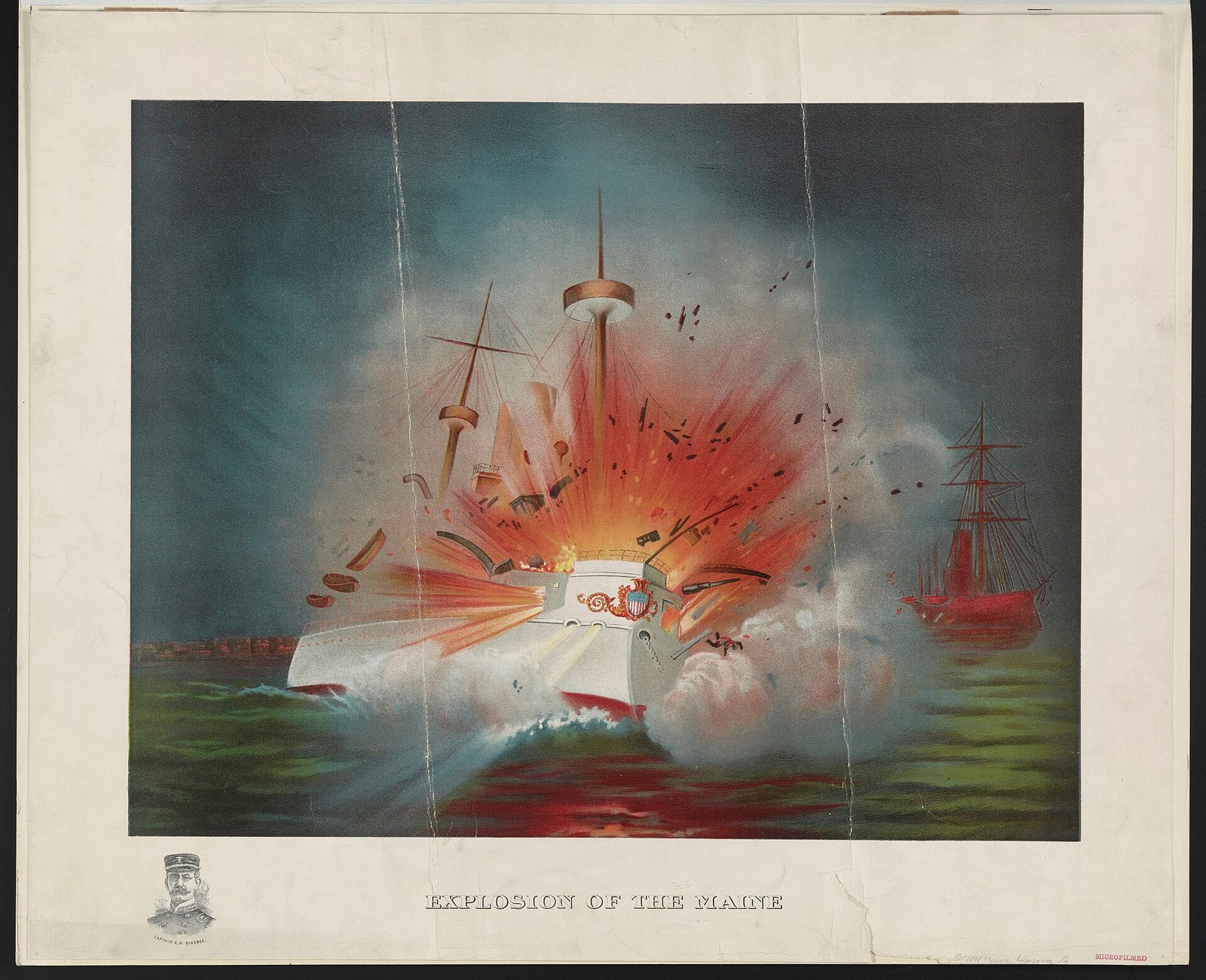
On the night of February 15, 1898, a catastrophic explosion rocked Havana Harbor, claiming the lives of 266 crew members aboard the USS Maine, an American battleship. The Maine was anchored in the harbor ostensibly to protect American interests during the Cuban War of Independence, which had been marked by a brutal struggle against Spanish colonial rule. The explosion not only resulted in a tragic loss of life but also ignited a wave of public outrage across the United States, leading to a fervent call for war against Spain. This incident marked a pivotal moment in U.S. history, setting the stage for the Spanish-American War and a significant shift in American foreign policy toward imperialism.
The USS Maine: A Symbol of American Power
Commissioned in 1895, the USS Maine was one of the first American battleships designed for modern naval warfare. Built at the Brooklyn Navy Yard, the ship was intended to showcase American naval strength and protect U.S. interests abroad. By early 1898, tensions were escalating between the United States and Spain due to Spain's oppressive rule over Cuba, which had sparked a rebellion. The Maine was sent to Havana to demonstrate American support for the Cuban revolutionaries and to safeguard American citizens and property in the area [1][3].
The Maine's presence in Havana was part of a broader American strategy to intervene in the Cuban conflict. The ship was well-received by the Cuban populace, who viewed it as a symbol of hope against Spanish tyranny. However, the political climate in the United States was fraught with tension. The so-called "Yellow Press," led by newspaper magnates William Randolph Hearst and Joseph Pulitzer, was sensationalizing events in Cuba, portraying the Spanish as brutal oppressors and stirring public sentiment in favor of intervention [2]. The media's portrayal of the conflict was not merely a reflection of events but rather a catalyst that shaped public opinion and influenced government action.
The Explosion: A Night of Tragedy
At 9:40 PM on February 15, the Maine was rocked by a massive explosion. The blast tore a gaping hole in the ship's hull, causing it to sink rapidly. Rescue efforts were hampered by the chaos that ensued, and many sailors were trapped below decks. Eyewitness accounts described the scene as chaotic, with flames and smoke engulfing the ship [1][2]. The immediate aftermath was one of confusion and horror, as the crew struggled to comprehend what had just happened.
In the wake of the explosion, the U.S. government ordered an investigation to determine the cause. The Navy appointed a board of inquiry, led by Captain William T. Sampson, to conduct a thorough examination of the wreckage. However, before the investigation could yield any definitive conclusions, public opinion had already begun to shift dramatically. The cry of "Remember the Maine!" became a rallying cry for those advocating for war against Spain, fueled by the sensationalist coverage in the press [3]. The phrase encapsulated the growing sentiment among Americans who were eager for retribution against Spain, regardless of the actual circumstances surrounding the explosion.
The Yellow Press and Its Influence
The Yellow Press played a crucial role in shaping public perception of the Maine explosion. Hearst's New York Journal and Pulitzer's New York World published inflammatory articles that suggested Spanish sabotage was responsible for the disaster. These newspapers often relied on dubious sources and exaggerated claims to sell papers, but their influence on public opinion was undeniable. They painted a picture of a treacherous Spain, intent on harming American interests [2]. The sensationalist reporting created a climate of fear and anger among the American public.
Many citizens were quick to accept the narrative that Spain had deliberately attacked the Maine, despite the lack of evidence. The press's portrayal of the Spanish as barbaric and cruel further fueled the desire for military action. As a result, calls for war grew louder, and politicians began to feel pressure to respond to public sentiment [3]. The media's role in this context cannot be overstated; it transformed a tragic incident into a rallying point for nationalistic fervor, pushing the United States closer to war.
The Sampson Board Findings: A Controversial Investigation
The Navy's investigation into the Maine explosion, conducted by the Sampson Board, concluded that the ship had been destroyed by a mine, which they attributed to Spanish forces. The report, released in March 1898, stated that the explosion was caused by an external force, leading many to believe that Spain was responsible for the tragedy [1]. However, the findings were met with skepticism by some, who argued that the evidence was inconclusive and that the explosion could have been caused by an accident or internal malfunction.
Critics of the Sampson Board's findings pointed out that the investigation was rushed and lacked thoroughness. The board had only a limited amount of time to examine the wreckage, and many believed that a more comprehensive investigation was necessary to determine the true cause of the explosion. This skepticism was compounded by the fact that the board's conclusions aligned perfectly with the prevailing narrative pushed by the Yellow Press [2][3]. The rush to judgment reflected a broader trend in American society at the time, where emotional responses often overshadowed careful analysis.
Forensic Debates and Alternative Theories
In the years following the explosion, forensic debates continued regarding the cause of the Maine's destruction. Some historians and researchers have suggested alternative theories, including the possibility of an accidental explosion caused by coal dust igniting in the ship's bunkers. This theory posits that the Maine may have suffered from a spontaneous combustion incident, which could have been exacerbated by the ship's design and the conditions in Havana Harbor [1]. Such theories challenge the narrative that Spain was solely responsible for the explosion and highlight the complexities involved in maritime accidents.
Further investigations, including those conducted by the U.S. Navy in the 1970s, have also raised questions about the original conclusions drawn by the Sampson Board. These later studies suggested that the evidence for a mine explosion was not as definitive as previously thought. The debate over the cause of the Maine explosion continues to this day, with some historians arguing that the rush to blame Spain was politically motivated and that the truth may never be fully known [1][3]. The ongoing discussions surrounding the incident underscore the importance of critical examination in historical narratives and the potential for bias in interpreting events.
The Aftermath: A War Ignited
The explosion of the USS Maine served as a catalyst for the Spanish-American War, which officially began in April 1898. Fueled by public outrage and the media's relentless push for intervention, Congress declared war on Spain on April 25, 1898. The war was characterized by a series of swift military victories for the United States, culminating in the defeat of Spanish forces in both Cuba and the Philippines [3][5]. The conflict marked a significant turning point in American foreign policy, as the nation transitioned from a focus on continental expansion to overseas imperialism.
The phrase "Remember the Maine!" became synonymous with American nationalism and a call to arms. The war resulted in significant territorial gains for the United States, including Puerto Rico, Guam, and the Philippines, marking a shift in American foreign policy toward imperialism. The conflict also raised questions about the morality of American intervention and the treatment of newly acquired territories, setting the stage for future debates about U.S. involvement in foreign affairs [4][5]. The war's outcomes prompted discussions about the responsibilities of the United States as an emerging global power and the ethical implications of its actions.
The Legacy of the USS Maine Explosion
The legacy of the USS Maine explosion and the subsequent Spanish-American War is complex. While the war is often viewed as a triumph of American military power, it also raised ethical questions about imperialism and the consequences of intervention. The explosion itself remains a symbol of the dangers of hasty conclusions and the influence of sensationalist media on public opinion [2][3]. The events surrounding the Maine serve as a reminder of how easily public sentiment can be swayed by media narratives, often leading to significant political and military consequences.
In the years following the war, the USS Maine became a memorial to those who lost their lives in the explosion. The Maine Memorial, located in Havana Harbor, serves as a reminder of the sacrifices made during the conflict and the enduring impact of the events of 1898 on U.S. history. The memorial stands as a testament to the lives lost and the complex legacy of the Spanish-American War [4]. It is a physical representation of the intersection between military history and national identity, reminding future generations of the costs of war and the importance of understanding the past.
Conclusion: A Cautionary Tale
The explosion of the USS Maine in Havana Harbor on February 15, 1898, was a pivotal moment in American history. It exemplified the power of media to shape public opinion and the consequences of rushing to judgment in the face of tragedy. The ensuing Spanish-American War marked a significant turning point in U.S. foreign policy, leading to a new era of American imperialism. As debates about the true cause of the Maine explosion continue, the incident serves as a cautionary tale about the interplay between politics, media, and military action. The legacy of the Maine reminds us that history is often shaped by a confluence of factors, including public sentiment, media influence, and the actions of those in power.