
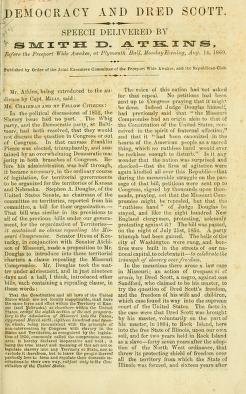
The Dred Scott Decision: A Turning Point in American History
On March 6, 1857, the Supreme Court of the United States delivered its ruling in Dred Scott v. Sandford, a decision that would have profound implications for the nation. The Court ruled that Dred Scott, an enslaved man who had sued for his freedom, remained a slave and that Congress lacked the authority to prohibit slavery in the territories. This ruling not only denied Scott his freedom but also intensified the national debate over slavery, contributing to the escalating tensions that would lead to the Civil War. The decision represented a culmination of legal and political battles over slavery that had been brewing for decades, and it highlighted the deep divisions within American society.
The Background of Dred Scott's Case
Dred Scott was born into slavery in Virginia around 1799. His early life was marked by the harsh realities of enslavement, but he would eventually find himself at the center of a legal battle that would change the course of American history. In 1830, he was purchased by an army surgeon, Dr. John Emerson, who took him to various military posts, including Illinois and the Wisconsin Territory, areas where slavery was prohibited by the Missouri Compromise of 1820. This compromise was an attempt to maintain a balance between slave and free states, but it also sowed the seeds of conflict that would erupt in the coming years.
After Emerson's death in 1843, Scott attempted to secure his freedom based on his residence in free territories. He filed his first lawsuit in 1846 against Emerson's widow, claiming that his time spent in free states entitled him to emancipation. The case was initially heard in a Missouri court, where he won, but the decision was appealed. The legal questions surrounding Scott's status as a slave and the rights of Congress to regulate slavery in the territories became central to the case, drawing national attention and highlighting the contentious nature of slavery in America.
The Taney Court's Opinion
Chief Justice Roger B. Taney, writing for the majority, articulated several key points in the Court's opinion. First, Taney asserted that Scott, as a person of African descent, could not be a citizen of the United States and therefore had no standing to sue in federal court. This assertion was based on a narrow interpretation of citizenship that excluded black individuals, regardless of their status as free or enslaved. Taney's opinion stated, "They [African Americans] had for more than a century been regarded as beings of an inferior order" and were "not intended to be included under the word 'citizens' in the Constitution" [1]. This ruling effectively stripped African Americans of any legal recognition or rights, reinforcing the systemic racism that permeated American society.
The Court also addressed the issue of Congress's authority over slavery in the territories. Taney concluded that the Missouri Compromise was unconstitutional because it violated the Fifth Amendment, which protects against the deprivation of property without due process. By this reasoning, the federal government could not prohibit slavery in the territories, as doing so would infringe upon the property rights of slaveholders [2]. This ruling effectively opened all territories to the possibility of slavery, a decision that alarmed many in the North and galvanized anti-slavery sentiment.
The Reaction to the Dred Scott Decision
The Dred Scott decision was met with outrage in the Northern states. Abolitionists and many Republicans viewed the ruling as a blatant attempt to expand slavery and undermine the rights of free states. Prominent figures like Frederick Douglass condemned the decision, stating that it was a "disgraceful" ruling that would be "reversed by the judgment of history" [3]. The Republican Party, which had been founded on the principles of opposing the expansion of slavery, used the decision to galvanize support against the pro-slavery agenda. The ruling became a rallying point for those who sought to challenge the institution of slavery and advocate for the rights of African Americans.
In response to the ruling, many Northern states began to pass personal liberty laws, which aimed to counteract the enforcement of the Fugitive Slave Act and protect free blacks from being captured and returned to slavery. These laws were a direct challenge to the federal government's authority and highlighted the growing divide between the North and South. The Dred Scott decision not only intensified existing tensions but also pushed many moderates into the anti-slavery camp, as they recognized the threat posed by the ruling to the principles of freedom and equality.
The Implications for Citizenship and Rights
The Dred Scott decision had far-reaching implications for citizenship and civil rights in America. By declaring that African Americans could not be citizens, the Court effectively denied them any legal rights or protections under the Constitution. This ruling set a dangerous precedent, reinforcing the notion that black individuals were not entitled to the same rights as white citizens. The implications of this decision extended beyond Scott's case; it affected countless African Americans who were denied their humanity and legal standing in society.
The decision also raised questions about the future of the Union. With the Court siding with pro-slavery interests, many in the North feared that the federal government would continue to support the expansion of slavery into new territories and states. This fear contributed to the rise of sectional tensions and the eventual outbreak of the Civil War. The Dred Scott ruling underscored the fragility of the Union and the deep-seated divisions that existed within the country, foreshadowing the violent conflict that would soon erupt.
The Political Landscape After Dred Scott
The Dred Scott decision significantly altered the political landscape in the United States. It intensified the conflict between pro-slavery and anti-slavery factions, leading to increased polarization. The Republican Party, which had gained momentum in the 1850s, used the ruling to rally support against the expansion of slavery. Prominent Republicans, including Abraham Lincoln, condemned the decision and argued that it was a threat to the principles of freedom and equality upon which the nation was founded.
Lincoln, in particular, articulated a vision of America that rejected the notion of slavery's expansion. In his famous "House Divided" speech in 1858, he stated, "A house divided against itself cannot stand. I believe this government cannot endure, permanently half slave and half free" [4]. This sentiment resonated with many Americans who were increasingly concerned about the implications of the Dred Scott ruling. The decision became a focal point in the political discourse of the time, as it highlighted the moral and ethical dilemmas surrounding slavery and its expansion.
The ruling also had implications for the Democratic Party, which was divided between Northern Democrats who opposed the expansion of slavery and Southern Democrats who supported it. This division weakened the party and contributed to the rise of the Republican Party as a formidable political force. The Dred Scott decision thus played a crucial role in reshaping the political landscape, setting the stage for the contentious elections of the late 1850s and early 1860s.
The Legacy of Dred Scott v. Sandford
The legacy of the Dred Scott decision is profound and enduring. It not only denied freedom to one man but also reinforced a system of racial inequality that would persist for generations. The ruling was a catalyst for the Civil War, as it crystallized the divisions between North and South and galvanized anti-slavery sentiment. The decision is often cited as one of the key events that led to the outbreak of the Civil War, as it made clear the extent to which the nation was divided over the issue of slavery.
In the years following the Civil War, the Thirteenth, Fourteenth, and Fifteenth Amendments were passed, fundamentally altering the legal status of African Americans. The Thirteenth Amendment abolished slavery, the Fourteenth granted citizenship to all persons born or naturalized in the United States, and the Fifteenth prohibited the denial of the right to vote based on race. These amendments were direct responses to the injustices highlighted by the Dred Scott decision and aimed to rectify the wrongs of the past. However, the struggle for true equality and civil rights continued long after these amendments were ratified.
The Dred Scott decision also served as a reminder of the fragility of civil rights and the ongoing struggle for justice in America. The ruling's impact can be seen in subsequent legal battles and civil rights movements, as activists sought to dismantle the systemic racism that had been entrenched by the Court's opinion. The decision's legacy is a testament to the importance of vigilance in protecting the rights of all citizens, regardless of race.
The Supreme Court's Role in American Society
The Dred Scott case also raised important questions about the role of the Supreme Court in American society. The Taney Court's ruling demonstrated how the judiciary could be used to uphold and protect the interests of a powerful minority at the expense of the rights of the majority. This case serves as a reminder of the potential for judicial decisions to have far-reaching consequences, particularly when they reflect the prevailing social and political attitudes of the time. The Court's decision in Dred Scott exemplified how legal interpretations could be manipulated to serve the interests of those in power.
In the years since the Dred Scott decision, the Supreme Court has continued to grapple with issues of race, citizenship, and civil rights. Landmark cases such as Brown v. Board of Education (1954) and Loving v. Virginia (1967) have sought to rectify the injustices that were perpetuated by earlier rulings, including Dred Scott. These cases demonstrate the ongoing struggle for equality and justice in America, as well as the evolving interpretation of constitutional rights. The legacy of Dred Scott serves as a cautionary tale about the potential for the judiciary to reinforce systemic injustices and the necessity of continual advocacy for civil rights.
The Enduring Impact of Dred Scott v. Sandford
The Dred Scott v. Sandford decision remains one of the most controversial and consequential rulings in the history of the United States. It not only denied freedom to an individual but also set the stage for a national crisis that would culminate in the Civil War. The ruling's implications for citizenship and civil rights continue to resonate today, reminding us of the ongoing struggle for equality and justice in American society. The decision is often invoked in discussions about race relations, civil rights, and the role of the Supreme Court, highlighting its lasting significance.
The Dred Scott decision serves as a powerful example of how the law can be wielded to uphold systemic injustice. As we reflect on this pivotal moment in history, it is essential to recognize the lessons it imparts about the importance of safeguarding civil rights and ensuring that the principles of democracy are upheld for all citizens, regardless of race. The struggle for equality is ongoing, and the legacy of Dred Scott reminds us that vigilance is necessary to protect the rights of all individuals in the face of systemic oppression.