
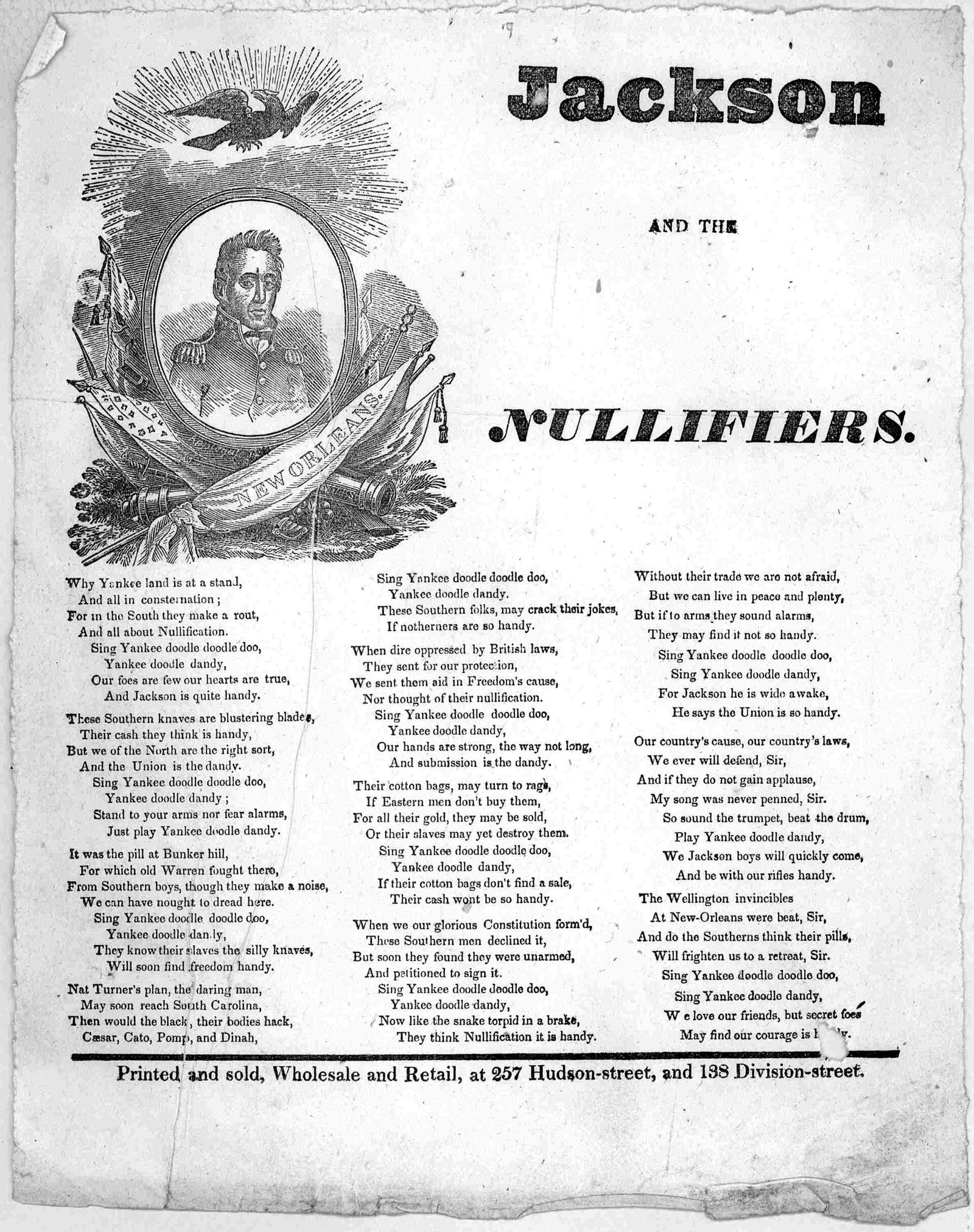
The Nullification Crisis of 1832: South Carolina's Stand Against Federal Tariffs
In the early 1830s, South Carolina found itself at the center of a fierce political battle over federal tariffs. In November 1832, the state declared federal tariffs void within its borders through the Ordinance of Nullification [2]. This bold move was met with a strong response from President Andrew Jackson, who threatened military action to enforce federal law [3]. The crisis escalated tensions between state and federal authority, ultimately leading to a compromise that would shape the future of American politics.
Background: The Tariff of Abominations and Its Impact
The roots of the Nullification Crisis can be traced back to the Tariff of 1828, often referred to as the "Tariff of Abominations" [4]. This legislation imposed high tariffs on imported goods, aiming to protect Northern manufacturers at the expense of Southern agricultural interests. Southern states, particularly South Carolina, were outraged. They relied heavily on imported goods and felt the tariffs unfairly burdened their economy. The economic distress in the South was exacerbated by a nationwide economic downturn, leading to widespread discontent with the federal government.
John C. Calhoun, a prominent South Carolinian politician and Jackson's vice president, emerged as a leading voice against the tariffs. He argued that states had the right to nullify federal laws they deemed unconstitutional [5]. Calhoun's theory of nullification was rooted in the belief that the Constitution was a compact among sovereign states, allowing them to reject federal authority when it overstepped its bounds. His ideas gained traction in South Carolina, where many viewed the tariffs as an existential threat to their way of life. The economic implications were dire; many Southern farmers faced increased costs for goods they depended on, leading to a growing resentment towards the federal government.
The Tariff of 1828 was particularly damaging to South Carolina's economy, which was heavily reliant on cotton production. The state exported large quantities of cotton to Europe, and the tariffs made imported goods more expensive, squeezing the profits of Southern planters. This economic hardship fueled the belief that the federal government was favoring Northern industrial interests over Southern agricultural needs. The growing discontent was not just about economics; it was also about a perceived loss of autonomy and respect for state rights.
The Ordinance of Nullification: A Bold Declaration
On November 24, 1832, the South Carolina legislature passed the Ordinance of Nullification, declaring the tariffs of 1828 and 1832 null and void within the state [2]. This act was a direct challenge to federal authority and set the stage for a confrontation between South Carolina and the federal government. The ordinance stated that if the federal government attempted to enforce the tariffs, South Carolina would secede from the Union.
The declaration was not merely a symbolic gesture; it was a calculated move by South Carolina's leaders to assert their rights. The state prepared for potential conflict by organizing a militia and stockpiling arms. The atmosphere in South Carolina was charged with a sense of rebellion, and many residents rallied behind the idea of nullification as a means of protecting their economic interests and state sovereignty. The state’s leaders believed that they were standing up for their rights and the rights of all Southern states, which they felt were being oppressed by federal policies.
The Ordinance of Nullification was met with mixed reactions within South Carolina. While many supported the move, others were concerned about the potential consequences of secession. The fear of military confrontation with the federal government loomed large, and some citizens questioned whether the state could survive economically outside the Union. Nevertheless, the ordinance represented a significant moment in the assertion of state rights, and it galvanized support for the nullification movement across the South.
Jackson's Response: The Force Bill of 1833
President Andrew Jackson, a staunch supporter of federal authority, viewed the nullification crisis as a direct threat to the Union. In response to South Carolina's actions, he issued a proclamation on December 10, 1832, asserting that nullification was incompatible with the existence of the Union [1]. Jackson emphasized that the federal government would not tolerate any attempts to undermine its authority, stating, "The Union must be preserved" [1]. His proclamation was a clear warning to South Carolina that the federal government would take decisive action to maintain order.
To back up his words, Jackson sought congressional approval for the Force Bill, which would authorize him to use military force to enforce federal laws in South Carolina. The Force Bill was introduced in early 1833 and passed by Congress, allowing Jackson to deploy troops if necessary [3]. This move underscored Jackson's commitment to maintaining federal supremacy and his willingness to use military power to quell dissent. The Force Bill was a significant escalation in the conflict, as it indicated that the federal government was prepared to use force to uphold its laws.
The prospect of military intervention alarmed many in South Carolina. While some residents were prepared to fight for their rights, others feared the consequences of a violent confrontation with the federal government. The situation became increasingly tense as both sides prepared for a potential showdown. Jackson's determination to enforce federal law put South Carolina's leaders in a difficult position; they had to weigh their commitment to nullification against the potential for devastating conflict.
In the midst of this crisis, Jackson also sought to rally public opinion in favor of the federal government. He delivered speeches and wrote letters emphasizing the importance of national unity and the dangers of disunion. His administration worked to counter the narrative that the federal government was overstepping its bounds, portraying the nullification movement as a threat to democracy itself. This public relations campaign was crucial in shaping the national discourse around the crisis.
The Role of Henry Clay: Compromise and Resolution
Amidst the escalating crisis, Senator Henry Clay emerged as a key figure in seeking a peaceful resolution. Recognizing the potential for violence and the threat to national unity, Clay proposed a compromise tariff that would gradually reduce the rates imposed by the Tariff of Abominations [4]. His plan aimed to appease both Southern concerns and Northern interests. Clay understood that a compromise was necessary to avoid a civil conflict that could have catastrophic consequences for the nation.
In March 1833, Clay's compromise tariff was passed by Congress. It provided for a gradual reduction of tariffs over the next decade, ultimately lowering rates to a more acceptable level for Southern states [4]. The compromise was a significant step toward resolving the crisis, as it addressed some of the economic grievances that had fueled South Carolina's rebellion. Clay's ability to broker a compromise demonstrated his political acumen and his commitment to preserving the Union.
Simultaneously, Jackson and his administration sought to de-escalate tensions. The president agreed to suspend military action in South Carolina, signaling a willingness to negotiate rather than resort to force. The combination of Clay's compromise and Jackson's conciliatory approach helped to cool the crisis, allowing both sides to save face. The resolution of the Nullification Crisis was a testament to the power of negotiation and compromise in American politics.
However, the resolution did not eliminate the underlying issues that had led to the crisis. While the immediate conflict was resolved, the fundamental questions about state rights and federal authority remained unresolved. The compromise tariff did not fully satisfy either side, and tensions continued to simmer beneath the surface. The Nullification Crisis highlighted the fragility of the Union and the complexities of balancing state and federal interests.
The Aftermath: Lasting Implications of the Nullification Crisis
The Nullification Crisis had profound implications for the relationship between state and federal authority in the United States. While the immediate conflict was resolved through compromise, the underlying issues of states' rights and federal power remained contentious. The crisis set a precedent for future conflicts over state sovereignty, foreshadowing the more significant struggles that would arise in the years leading up to the Civil War. The idea that states could challenge federal authority would resurface in various forms throughout American history [5].
The events of 1832-1833 also highlighted the growing sectional divide between the North and South. The South's reliance on agriculture and its opposition to tariffs contrasted sharply with the North's industrial interests. This economic disparity would continue to fuel tensions, ultimately culminating in the secession of Southern states and the outbreak of the Civil War in the 1860s. The Nullification Crisis served as a precursor to the larger conflicts that would engulf the nation, revealing the deep-seated divisions that existed.
In the wake of the crisis, South Carolina's leaders maintained their commitment to the principles of nullification. Although the immediate threat of secession was averted, the idea that states could challenge federal authority persisted. This notion would resurface in various forms throughout American history, influencing debates over civil rights, segregation, and federal intervention in state matters. The legacy of the Nullification Crisis can be seen in the ongoing struggles over states' rights and federal power that continue to shape American political discourse.
The crisis also had a lasting impact on the political landscape of the United States. It contributed to the rise of sectionalism, as Southern states increasingly viewed themselves as distinct from the North. The tensions between state and federal authority would continue to evolve, leading to significant political realignments and the emergence of new political parties. The Democratic Party, which Jackson helped to establish, would grapple with the challenges of balancing state rights with the need for a strong federal government.
Conclusion: The Legacy of the Nullification Crisis
The Nullification Crisis serves as a pivotal moment in American history, illustrating the delicate balance between state and federal power. South Carolina's defiance of federal tariffs and Jackson's resolute response underscored the tensions that would continue to shape the nation. The compromise reached in 1833 provided a temporary solution, but the underlying issues of states' rights and federal authority remained unresolved.
As the nation moved forward, the lessons learned from the Nullification Crisis would resonate in future political battles. The crisis highlighted the importance of dialogue and compromise in addressing deep-seated grievances, a principle that remains relevant in contemporary political discourse. The events of 1832-1833 remind us that the struggle for power and authority is an enduring theme in American history, one that continues to evolve in the face of changing circumstances.
The Nullification Crisis also serves as a reminder of the potential consequences of extreme political actions. The willingness of South Carolina to assert its rights through nullification demonstrated the lengths to which states might go to protect their interests. At the same time, Jackson's readiness to use military force to uphold federal authority illustrated the federal government's commitment to maintaining the Union. This tension between state and federal power would continue to be a defining feature of American governance, influencing debates over issues ranging from civil rights to healthcare.
In retrospect, the Nullification Crisis was not merely a regional dispute; it was a reflection of the broader struggles that would define the United States in the years to come. The crisis set the stage for future conflicts, revealing the complexities of governance in a diverse and rapidly changing nation. The legacy of the Nullification Crisis continues to resonate, reminding us of the enduring challenges of balancing state rights with the need for a cohesive national identity.