
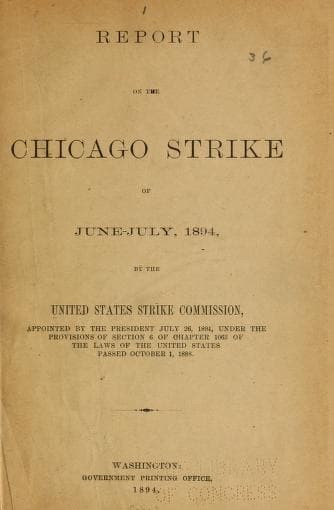
The Pullman Strike of 1894: A National Crisis in Chicago
In May 1894, a wage cut at the Pullman Company in Chicago ignited a massive labor strike that paralyzed rail traffic across the United States. Workers, led by the American Railway Union (ARU) and its president Eugene Debs, protested against the Pullman Company’s decision to reduce wages while maintaining high rents in the company-owned town of Pullman. The strike escalated quickly, leading to a nationwide boycott of trains carrying Pullman cars. By July, the federal government intervened, sending troops to Chicago to break the strike, resulting in violent clashes and significant casualties. This event not only highlighted the struggles of labor in America but also marked a pivotal moment in the relationship between government and labor.
The Pullman Company and Its Town
The Pullman Company was founded by George Pullman in 1867, initially focusing on manufacturing luxury railroad cars. Pullman envisioned a model community for his workers, which he established in 1880. The town of Pullman, located just south of Chicago, was designed to provide a high quality of life for its residents, featuring well-built homes, parks, and schools. However, the reality was more complicated. While the town was aesthetically pleasing, it was also a company town where the Pullman Company controlled nearly every aspect of life. Residents paid rent to the company, which was often high relative to their wages.
By the early 1890s, the economic downturn known as the Panic of 1893 hit the nation hard. The Pullman Company, facing financial difficulties, decided to cut wages by about 25% without reducing rents in the town. This decision sparked outrage among workers, who felt trapped in a system that exploited them. The wage cut was not merely a financial blow; it was a direct attack on their dignity and livelihoods. The workers' grievances were compounded by the fact that many of them had already been struggling to make ends meet due to the economic downturn, and the wage cuts only exacerbated their plight [1][2].
Eugene Debs and the American Railway Union
Eugene Debs, a prominent labor leader and socialist, became a key figure in the Pullman Strike. Debs had previously founded the ARU in 1893, which aimed to unite all railway workers, regardless of their specific job or union affiliation. The ARU quickly grew in membership, advocating for better working conditions and fair wages. Debs was known for his passionate speeches and commitment to the labor movement, which resonated with many workers who felt marginalized by corporate interests.
When the wage cuts were announced, Debs and the ARU supported the Pullman workers in their fight against the company. The union called for a boycott of all trains carrying Pullman cars, which quickly gained traction. By June 1894, the strike had escalated to a national level, disrupting rail traffic across the country. The ARU's actions were not just about Pullman; they represented a broader struggle for workers' rights in an era marked by economic inequality and corporate power. The strike was a rallying point for labor activists, who saw it as an opportunity to challenge the status quo and demand better treatment from employers [3][5].
The Nationwide Boycott and Its Impact
The boycott initiated by the ARU had immediate and far-reaching consequences. Railroads across the nation began to feel the impact as trains were halted, and freight shipments were delayed. Major railroads, including the Illinois Central and the Atchison, Topeka and Santa Fe, found their operations crippled. The strike also drew in sympathy from other labor organizations, leading to a wave of solidarity strikes across various industries. Workers from different sectors joined the cause, recognizing that their struggles were interconnected.
As the strike continued, tensions escalated. The federal government, under President Grover Cleveland, viewed the strike as a threat to interstate commerce and public order. The situation in Chicago became increasingly volatile, with clashes between strikers and law enforcement. The strike was not just a labor dispute; it had become a national crisis, drawing attention from politicians, the media, and the public. The media coverage of the strike often portrayed the strikers as violent and unruly, which further fueled public sentiment against them. This portrayal was significant in shaping the narrative around the strike and influencing government actions [2][4].
Federal Intervention: Troops in Chicago
By early July 1894, the situation had deteriorated to the point where federal intervention was deemed necessary. President Cleveland, responding to pressure from railroad executives and fearing the strike's impact on the upcoming mail delivery, ordered federal troops to Chicago. The deployment of troops was controversial and marked a significant escalation in the government's response to labor unrest. The decision to send troops was justified by the government as a means to restore order and protect commerce, but it was met with fierce opposition from labor leaders and activists.
On July 4, 1894, federal troops arrived in Chicago, and violence erupted almost immediately. Strikers clashed with soldiers, leading to riots and confrontations that resulted in several deaths and injuries. The presence of troops was a clear signal that the government would not tolerate the disruption of commerce, and it marked a turning point in labor relations in the United States. The violence that ensued shocked the nation and raised questions about the government's role in labor disputes. The use of military force against striking workers was unprecedented and set a troubling precedent for future labor conflicts [1][3].
The Injunction That Crushed the Strike
In addition to sending troops, the federal government sought legal means to suppress the strike. A federal judge issued an injunction against the ARU, declaring the strike illegal. The injunction was based on the argument that the strike interfered with mail delivery and interstate commerce, which were protected under federal law. This legal maneuver effectively criminalized the strike and gave the government the justification it needed to act forcefully against the workers. The use of injunctions against labor strikes became a common tactic in the years that followed, as employers and the government sought to undermine workers' rights to organize and protest.
The ARU's leadership, including Debs, was arrested for violating the injunction. Debs famously stated that he would rather be in jail than betray the cause of labor. His arrest and the subsequent legal battles highlighted the lengths to which the government would go to protect corporate interests over workers' rights. The legal and military actions taken against the strikers demonstrated a clear alignment between the government and big business, which would have lasting implications for labor relations in the United States [2][5].
The Aftermath: Casualties and Consequences
The Pullman Strike ended in mid-July 1894, but its repercussions were felt for years to come. The violence and chaos left several dead, with estimates of around 30 fatalities and hundreds injured. The strike's failure was a significant setback for the labor movement, leading to a decline in union membership and morale. Many workers who had participated in the strike faced retaliation from their employers, including blacklisting and job loss. The aftermath of the strike created an atmosphere of fear among workers, who were wary of organizing or speaking out against their employers.
In the wake of the strike, the federal government took a more active role in labor disputes, often siding with corporations. The events surrounding the Pullman Strike also highlighted the growing tensions between labor and government, setting the stage for future conflicts. The strike underscored the need for labor reform and better working conditions, which would eventually lead to significant changes in labor laws in the following decades. However, the immediate aftermath of the strike was marked by a retreat from organized labor and a temporary setback for the movement [1][4].
Labor Day: A Political Tool
Interestingly, the Pullman Strike also played a role in the establishment of Labor Day as a national holiday. In the aftermath of the strike, President Cleveland sought to appease the labor movement and the public by declaring Labor Day a federal holiday. This decision was partly a response to the unrest and aimed at demonstrating the government's acknowledgment of workers' contributions to the economy. The establishment of Labor Day was a strategic move to distance the administration from the violence of the Pullman Strike and to promote a more favorable image of labor.
Labor Day was officially established as a federal holiday in June 1894, just days after the strike ended. The timing was not coincidental; it was a political move to placate labor leaders and show that the government recognized the importance of workers. The holiday has since evolved into a celebration of workers' rights and achievements, but its origins are deeply rooted in the struggles of the labor movement. The establishment of Labor Day also served to highlight the ongoing challenges faced by workers and the need for continued advocacy for labor rights [3][5].
The Legacy of the Pullman Strike
The Pullman Strike of 1894 remains a significant event in American labor history. It highlighted the challenges faced by workers in a rapidly industrializing nation and the lengths to which they would go to fight for their rights. The strike also illustrated the complex relationship between labor and government, a dynamic that continues to evolve today. The events of the strike prompted discussions about labor laws and the need for reforms to protect workers. While the immediate aftermath of the strike was bleak for labor unions, it laid the groundwork for future organizing efforts and the eventual establishment of labor rights in the United States.
Eugene Debs emerged from the strike as a national figure and a symbol of the labor movement. His commitment to socialism and workers' rights would influence generations of labor activists. Debs later ran for president multiple times as a socialist candidate, advocating for the rights of workers and the need for systemic change in American society. His legacy as a labor leader is still celebrated today, and he remains an important figure in discussions about workers' rights and social justice [2][4].
The Pullman Strike also prompted a reevaluation of labor relations in the United States. It exposed the deep-seated tensions between workers and corporations, as well as the role of the government in mediating these conflicts. The strike's legacy continues to resonate today, reminding us of the ongoing struggle for workers' rights and the importance of solidarity in the face of adversity. The events of 1894 serve as a powerful reminder of the sacrifices made by those who fought for fair wages and working conditions, and they highlight the need for continued advocacy for labor rights in an ever-changing economic landscape [1][3].
Conclusion: A Turning Point in Labor Relations
The Pullman Strike of 1894 was more than just a labor dispute; it was a turning point in American history. It exposed the deep-seated tensions between workers and corporations, as well as the role of the government in mediating these conflicts. The strike's legacy continues to resonate today, reminding us of the ongoing struggle for workers' rights and the importance of solidarity in the face of adversity. As we reflect on the events of 1894, it is essential to recognize the sacrifices made by those who fought for fair wages and working conditions. The Pullman Strike serves as a reminder of the power of collective action and the need for continued advocacy for labor rights in an ever-changing economic landscape.
The lessons learned from the Pullman Strike have influenced labor movements throughout the 20th century and into the present day. The ongoing challenges faced by workers, including wage stagnation, unsafe working conditions, and the erosion of union rights, echo the struggles of the past. As we continue to confront these issues, the legacy of the Pullman Strike serves as both a cautionary tale and a source of inspiration for those who seek to improve the lives of workers across the nation.